Baby Speech Milestones by Age
Worried your baby isn't talking yet? Here's a plain guide to speech milestones by age, real age ranges, and when to call your pediatrician.
Edited by Yu Asano/Updated /8 min read

Jump to a section
"My 18-month-old doesn't say any real words yet."
We typed something close to that into a phone at eleven at night, too. If that's about where you are tonight — you're in the right place. Nothing is wrong with you for looking this up. Let's walk through what sounds usually come when, and when a phone call makes sense.
What you'll find on this page
- What sounds usually come first, and when
- Why the "normal" range is wider than the checklists make it look
- Three things you can try tonight
- The signs that are worth a phone call
- Why official lists don't all match
Pick the stage that matches your child's age. Or jump to the call section if you are worried.
The short answer
Health officials' checklists put first sounds around 2 months and syllable babbling around 6 months. The speech therapists' chart puts a first word between 12 and 15 months and two-word phrases between 18 and 24 months. Both describe a wide normal range, and speech therapists say a few months either side of one list is usually still typical.
Use the table below to find your child's age. Then read the matching stage.
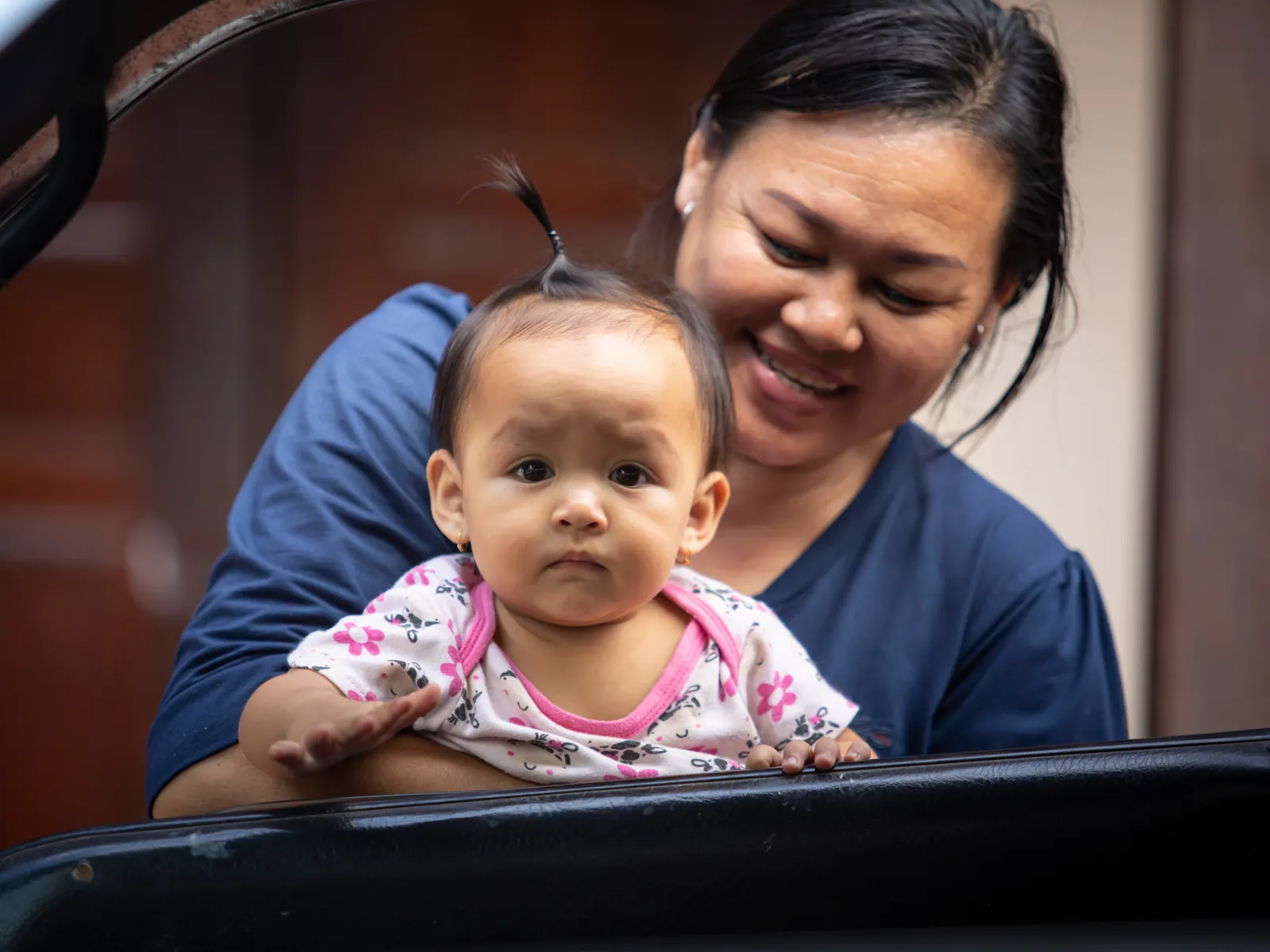
Baby speech milestones at a glance
| Months | What many babies do | The range — why lists differ |
|---|---|---|
| 2–3 | Coos, gurgles, turns toward your voice | Health officials list sounds at 2 months. The speech therapists' chart spans birth to 3 months for cooing. |
| 4–6 | Babbles with consonants ("ba," "da"), laughs | "Babbling" appears at 4 months on some lists, 6 on others — the researchers' list is one of the later ones. |
| 6–9 | Repeats syllables ("ba-ba-ba"), turns when called | Researchers count babble differently from study to study, so the ages shift. |
| 12 | Says "mama" or "dada," waves, understands "no" | Health officials' 2022 update moved some items to later ages. |
| 15–18 | Tries words beyond "mama/dada," points to show you things | First words land in a wide window. Some lists say 12 months. The speech therapists' chart says 12 to 15. |
| 24 | Puts two words together, like "more juice" | Speech therapists use a line of about 50 words at this age. Checklists set no word count. |
Stage 1: 0 to 3 months
- Cooing starts. Many babies make vowel sounds like "ooh" and "aah."
- They notice your voice. They may quiet down or smile when you speak.
- They turn toward sound. This includes your voice and other noises.
Researchers split communication into three parts: voice, speech, and language. A child can be strong in one and slower in another.
Social skills grow on their own timeline too. Studies of social-emotional development count smiling and back-and-forth sounds as part of it.
Try tonight: Talk, read, and sing through the day. Name what you are doing as you do it.
What to do now: Keep talking and naming. If your baby does not react to sound or your voice, call the doctor. These ideas come from health officials' 2-month checklist.
Stage 2: 4 to 9 months
- Consonants appear. Babbling starts with sounds like "ba," "da," and "ma."
- Syllables repeat. Researchers call this canonical babbling. You may hear "ba-ba-ba."
- Turn-taking begins. Your baby makes a sound, you answer, and they "reply."
One reason ages vary: a recent review pooled many babbling studies. The results shifted with how each study counted babble.
Try tonight: Copy your baby's sounds back, then pause so they can "answer."
What to do now: Keep up the back-and-forth. If your baby is not making sounds like "ba" and "da" yet, tell your child's doctor — health officials say not to wait for the next checkup. The milestones and tips above follow health officials' 6-month checklist.
Stage 3: 12 to 18 months
- First words often appear. Many say "mama" or "dada" around 12 months.
- Gestures grow. Many wave, point, and understand "no."
- Vocabulary builds. By 18 months, many try three or more words beyond "mama" and "dada."
First words land in a wide window. Some lists say 12 months. The speech therapists' chart says 12 to 15.
Try tonight: Name things during daily routines — "sock," "cup," "dog."
What to do now: Talk about everyday objects. If there are no real words by 18 months, call your pediatrician. These milestones come from health officials' 12-, 15-, and 18-month checklists.
Stage 4: 18 months to 2 years
- Word learning speeds up. Many toddlers add new words quickly.
- Two-word phrases start. Many put two words together around age 2: "more juice," "daddy go."
- Therapists watch word count. Speech therapists use a line of about 50 words by 24 months.
Try tonight: Read together and let your toddler point to pictures you name.
What to do now: Read and name pictures. If your child has fewer than 50 words or no two-word phrases at 2, ask for a screening. The 2-year milestones come from health officials' checklist. The 50-word line comes from speech therapists who work on late language emergence.
Three things you can try tonight
- Talk about what you are doing. Say "sock on" or "water cup" as you dress or feed. Babies learn words best when they hear them during real routines.
- Copy and pause. Repeat your baby's sound, then wait. This teaches them that sounds go back and forth.
- Point and name. Point to a toy or body part and say the word. Pairing the word with what they see helps it stick.
These ideas come from the everyday routines health officials recommend.
But the baby at daycare is already talking
It's hard when another child says more words. But milestones are not deadlines. They mark the age by which most children do something.
And "most" changed recently. In 2022, US health officials rebuilt their checklists. Each milestone now marks what at least 3 out of 4 children can do at that age. Before, some items showed what half of children could do. So some milestones moved later. Old lists still float around the internet.
Research has the same problem. Even babble counts change with the method a study uses.
Speech therapists have a term for late talking: late language emergence. It means a child at 24 months uses fewer than about 50 words, or is not yet putting two words together.
How common are speech and language delays? About 5 to 8 out of every 100 preschoolers have a speech or language delay, one review found. Clinical reviews call these some of the most common childhood developmental difficulties.
Here is the honest part. Many late talkers catch up on their own. But no test can tell ahead of time which child will, a large research review says.
If you are worried, ask early. That is the main takeaway from both doctors and researchers.
When it's worth making the call
- Any time you are worried. Health officials say not to wait for the next checkup. Tell your child's doctor what you noticed.
- Ask about a developmental screening. The doctor's office can do a short check.
- Call your state's early intervention program. You can ask for a free evaluation. Parents of children under 3 can call directly, without a referral.
- Ask for a hearing check too. Reviews list hearing problems among the common reasons speech runs late.
- Track milestones between visits. Health officials offer a free Milestone Tracker app for that.
KidsHealth, a children's health nonprofit, also has a plain guide to speech delays, written for parents.
These steps come from health officials' guidance for worried parents. Their guide for parents lists who to call in your state.
Start with your child's doctor or your state's early intervention program. Both are there for questions.
You can call with a question
Many late talkers catch up on their own — research reviews are clear on that. The reason to ask early is not because something is surely wrong. It is because health officials tell parents not to wait — they say help works best when it starts early, if your child needs it. You can call with a question. That is what doctors and early intervention are for.
About Baby Voice Recorder
This magazine is published by the team behind Baby Voice Recorder. It is a small recorder and parent app. It automatically picks up the words your child says. It saves them as short clips. You can see how their vocabulary changes week by week. It's a keepsake and a record, not a screening tool. It isn't out yet — join the waitlist if you'd like to hear when it is.
Sources
- Health officials
- researchers' list
- PubMed 41841005
- health officials
- speech therapists' chart
- Speech therapists
- researchers' definitions
- PubMed 30521240
- health officials' 6-month list
- health officials' 12-month list
- 15-month list
- 18-month list
- health officials' 2-year list
- PubMed 26208514
- PubMed 16452337
- PubMed 22918093
- free milestone tracker
- parent guide
- health officials' guidance on concerns and early intervention
- join the waitlist
Keep reading
- Baby Babbling Stages: What to Expect Month by MonthA plain-language month-by-month map of baby babbling, from first coos to first words, plus why the normal window is wider than the charts look and when to call the doctor.
- Baby Language Development Month by MonthIf your toddler isn't talking yet, here's what usually happens by age, why the range is wider than it looks, and when a phone call makes sense.
- Toddler Vocabulary by Age: A Month-by-Month MapHow many words toddlers usually say by 12, 18, 24, and 30 months, why the normal range is wide, and when to call your doctor.
Bayvo Magazine is published alongside Baby Voice Recorder, a wearable voice recorder for babies and toddlers that keeps the words a child actually says. It is still in development.
Bayvo Magazine gathers what public health agencies, speech therapists, and published research say. Every claim here is checked against the sources it links to, but this article is not individually reviewed by a clinician. It is not medical advice and it is not a diagnosis. If something worries you, talk to your child’s doctor.